
Well, stick around because, in this article, I will share everything you need to consider when choosing a suburb and ultimately a site.
I’ll also share some of the suburbs, I believe make sense, and some suburbs I don’t believe make sense.
Let’s get into it.
When it comes to undertaking duplex and dual occupancy projects here in the City of Geelong there is no question that it is a high risk, high reward game.
The first and arguably the biggest risk is ensuring you secure the right site to develop. You get this wrong, and all your efforts for the duration of the project will be wasted.
- Protection Overlays
- Block Dimensions
- Check the Area
- Sale Metrics
- Supply & Demand
- Experience
- Protection Overlays
Heritage or vegetation protection overlays, otherwise known as planning overlays, will make it more difficult when dealing with the council trying o achieve your approval.

Heritage overlays (HO) are used to protect sites that have heritage value, meaning that individual buildings or whole urban precincts may be covered.
Vegetation overlays (VPO) are used to protect significant vegetation through the planning scheme. Vegetation includes trees, shrubs, plants, grasses and wetland vegetation and their habitats. It also includes native and exotic vegetation. The City of Greater Geelong Planning Permit Checklist – Native Vegetation.
Significant Landscape overlays (SLO) has broader applicability than Vegetation Protection Overlays (VPO). Its function is to identify and conserve the character of a significant landscape. The SLO may also include VPO and permits required for building and works which can be applied where appropriate to assist in vegetation protection.
It’s not to say should never consider developing a site that has a protection overlay, all sites and situation are going to be different. They will need to be evaluated on their own merits.
It’s about being aware of them, so you aren’t caught off guard.
- Block Dimensions
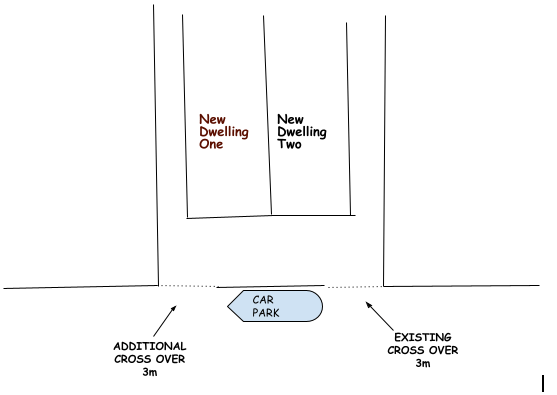
It’s not uncommon for suburbs or areas within suburbs to have the lots cut up in the exact block dimensions.
You want to look for suburbs with the lots cut up in sizes that lend themselves to the type of development you are looking to undertake.
For side by side dual occupancy developments, the ideal street frontage is 15 meters; this gives you enough width to allow for the two crossovers. Any bigger is a bonus.
It is possible to do a side by side on a 12-meter frontage, but it will depend on the council you are looking to develop in.
- Check the Area
There’s no substitution for an old-fashioned drive around. Get in your car and familiarise yourself with the area you are considering undertaking development.
Take note of what is being built and what kind of developments are getting approved.

Another option is to use online portals such as Vicplan (free), Google Earth (Free) and Landchecker (Paid subscription), where you can use aerial vision.
- Sale Metrics
When you are looking at a suburb you need to consider the sale metrics as far as what townhouses are selling for.
This will play an important role in helping you understand if doing a project in your selected area make sense from a number’s perspective.
Generally speaking, if townhouses aren’t seeling for enough on the other end, it will make it difficult to make a profit.
Again, generally speaking, the raw building costs are going to be similar regardless of area. Depending on the spec of course.
So it makes sense to do projects in areas that will see a premium on the other end.
For example…
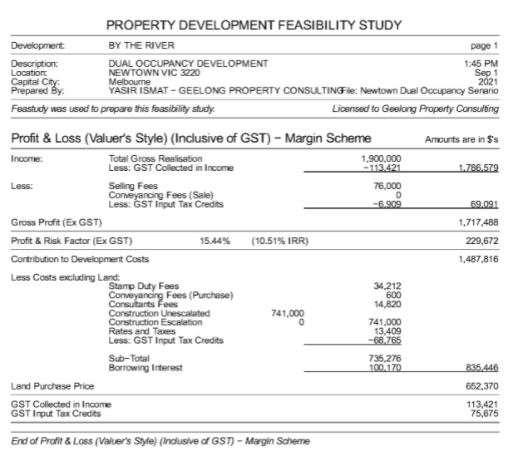
If you’re looking at a suburb where the purchase prices are around 600k – 700k and build a decent spec dual occupancy somewhere between that 700-800k level.
And townhouses sell for 1.9m- 2.0m instantly I can see that it leaves enough meat on the bone to make a profit.
On the flip side, if you are in a suburb where you can purchase a site for around 500-600k and then you build something modest around 700k – 800k
And the townhouse is selling 1.6m – 1.7m.
There simply isn’t enough money to purchase the site, pay the build cost, pay the development costs and still leave enough profit for it to make sense.
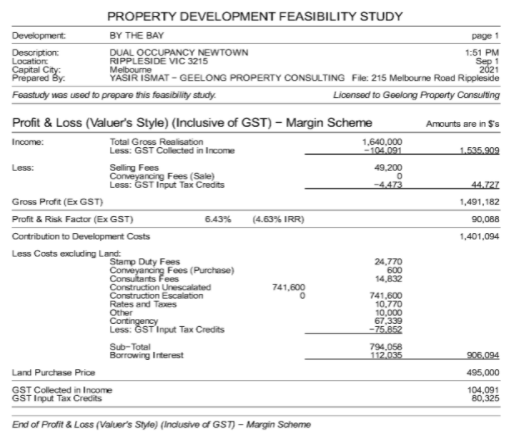
So essentially, what you are looking for is a nice gap between how much you can purchase a site and build for in relation to how much you can sell the townhouse on the other end.
The key is not to operate too close to the line.
If your goal is to make money it is important that you don’t let emotions play any part in your decision making.
- Supply & Demand
You need to consider supply and demand when deciding on a suburb to develop in. From experience, I have found that you get out from the CBD generally there is going to be a greater supply.
A suburb’s supply and demand you need to consider carefully.
The greater the supply. The harder it will be to sell your townhouses and by default, it will lower their value.
It’s not a good place to find yourself in after working hard to deliver your project.
You want to be looking at suburbs with higher buyer demand, which is generally around:
- Schools
- Parks
- Amenities
- Transport
- Shopping centres
- Villages
- Medical facilities
- Dining and entertainment precincts
- Sporting facilities
Universities are also good because you’ll have investors looking to purchase properties they can rent out for a premium.
It will be important that you consider where your site is in relation to these types of amenities.

The more of these boxes you can tick the better.
Working distance to parks, trains etc are all big ticks.
Once you find a suburb you are comfortable with and begin to do due diligence on specific sites, there are numbers of other variables you need to considers such as zoning, encumbrances, block gradient, site orientation and plan & permits.
- Experience
From my own experience, Dual Occupancy projects stack up best within the inner band of Geelong CBD.
As a general rule, the further you get out from CBD the less likely the numbers for your development will stack up.

Based on all the criteria pointed out throughout this article with tonner of experience some of the suburbs I find make sense include;
- Geelong West
- South Geelong
- Newtown
- East Geelong
- Belmont
And suburbs I find don’t work as well would be;
- Newcomb
- Grovedale
- Whittington
- Corio
- Norlane
Ultimately though when it comes to dual occupancy City of Greater Geelong selecting the suburb is very fluid, it’s a constant moving target so it is important that you do your own research.
It’s not only the first step in the process but perhaps the most important as well.
Now finally, if you are considering a site with plans and permits make sure you do your due diligence because it can be risky business if you don’t ask the right questions.
Do you live in the City of Greater Geelong? Are you thinking about undertaking your own dual occupancy build?
Why not reach out to Geelong Property Consulting, we’d love to hear from you at yasir@geelongpropertyconsulting.com.
 YASIR PROPERTY & REAL ESTATE ADVISORY SERVICES